Two papers in the works

I am currently working on finishing two manuscripts of journal papers for submission toe J. Acous. Soc. America (JASA) and J. Audio Eng. Soc. (JAES). The JASA paper is near completion and is on the topic of subjective expectations adjustments of spatial acoustic parameters and the JAES paper is on comparing subjective expectations of direct and reverberant sound levels given different presented visual stimuli.
|

Speakers.

DSC_0016

The WFS system is in place in the live room of Lab B. 32 channels of loudspeakers will reproduce spatially accurate audio to 1.1 kHz. This will be coupled with a 5-channel surround sound system to provide late reverberation. Calibration and testing will begin next week. To facilitate driving each channel simultaneously, two additional analog daughter-cards will be installed in the G5’s HDSP 9652 by RME. This will allow for 40 discrete channel outputs.

|

Wave Field Synthesis 32-channel Loudspeaker Array

gurley_3d

The new Wave Field Synthesis (WFS) loudspeaker array will be installed in the Gurley Lab this week. This hybrid virtualization system will provide from a highly spatial accurate (wavefront synthesis up to 1.1 kHz) frontal array coupled to a 2D HD video projection system. Room modeling will be accomplished in real-time using a custom convolver coupled to a surround speaker array. The WFS system will spatialize up to 16 virtual sources in a modeled room with up to second-order reflections. This reproduction system is similar to that used in my Master’s research, but with half the spacing between speakers in the frontal array (9.5 cm). The WFS system will be used for real-time telematic musical performances, research on audio-visual interactions and multi-modal distance perception.

|

Performance at RPI for NY Times

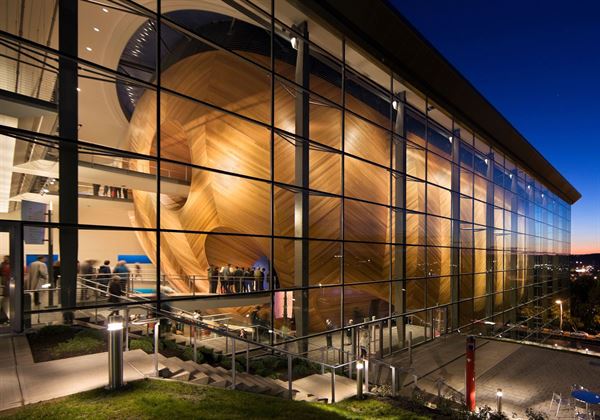
A NY Times reporter is coming to RPI on Tuesday, August 5th to tour the Ca3rl Lab and EMPAC Facility. During the visit Jonas Braasch, myself, and Pauline Oliveros will be performing telematically with Chris Chafe at Stanford University. The visit will focus on our research into live improvised music over the internet. The Times will be also visiting the Workspace Unlimited installation as well as other projects at EMPAC.

DSC_2633

|

Fronhofer Tool Triathlon

Yesterday I compted in the 2nd annual Fronhofer Tool Triathlon. It was an international distance race. I came in 11th place overall, and 1st in my age group. My time was 2 hours and 15 minutes.

DSC_2834

|

New Page in Site

After being frustrated about purchasing another item on ebay to carry my gear on my bike and being disappointed about it not working as advertised I have decided to devote a page on the site for reviewing gear specifically for carrying technology-based gear around on a bicycle. I commute to and from school almost every day and need to be able to comfortably and reliably carry around a lot of diverse and delicate items (laptops, audio equipment, camera equipment). Other than forums, there are not many resources on the net that provide high-quality photographic-based reviews for this type of gear. I will review some of the gear that I use, and have used in the past to share what has worked and what does not work so well.
|

Workspace Unlimited

I have been working with the group Workspace Unlimited to develop a 360 Degree sound spatialization patch to auralize there visual work. Using an adaptation of the ViMiC Wooster environment, we created a virtual surround panning algorithm which places an array of virtual speakers outside the array of virtual microphones. The virtual microphones pick up the loudspeaker signals and present them ins 360 degrees over the 32 loudspeakers. Provisions for room modeling are also added to generate a virtual recording space for the virtual loudspeakers. The patch is done, but we are having several clocking/jitter issues that will most likely be ironed out monday.
|

Musselman Triathlon Results

DSC_9047

I competed in the musselman half-ironman triathlon over the weekend. It was an intense day of 1.2 miles of swimming in 3 foot waves, 56 miles of biking in a 15 mph headwind and driving rain and 13.1 miles of running during a thunderstorm. Will I do it again? Absolutely. It was one of the greatest experiences of my life. I completed the whole race in 5 hours and 36 minutes.

|

Summer Work at EMPAC

I haven’t updated this site in a while and I will try to be better at this from now on. I’ll start off with a quick summary of what I have done since 2/3/08 when last i’ve last posted. It’s summer now and I have been working with the Electronic Music Foundation performing IT, acoustical design, and LEED tasks for the construction of their new headquarters in Albany, NY. This has been a fun a challenging project and should turn out quite nice when it is planned to be open (Sept 1, 08). I have also been working with EMPAC, RPI doing Max/MSP programming for a performance to be planned for the fall of this year. I can’t say much about it other than it calls for lots of speakers, computing power and high-resolution projectors. My ACTA Acustica-united with Acustica paper has been accepted with revisions which I am currently working on and plan on resubmitting in a week or two. I have a JASA paper in the final stages of draft form and I am also working on my Dissertation proposal, planned for September of this year. It’s been a busy last couple of months and hopefully all of my current projects will turn out well.
|

Verification Measurements for Acustica Paper Complete

I just finished taking verification impulse responses in the physical locations that I conducted subjective experiments in this past semester. These results will be used in an upcoming Acustica paper that I am submitting.
ABSTRACT:
The subject of auditory visual integration has become increasingly important with the introduction of high-resolution playback devices that allow for a high level of granularity in ob ject segregation on-screen. What, if any eect does the visual impression of a ob ject in a scene have on the sub jective impression of that ob ject’s auditory stimulus? Several studies have looked at the phenomenon in recent years, but limit the testing condition to static images, speech-only signals or photographs to represent the visual scene. In this paper we examine, with a high-definition visual presentation, the impact of a musician’s visual performance on the sub jective impression of that musician’s auditory performance. Moreover, this study reveals listener resiliency in the presence of forced auditory visual mismatch; respondents are able to adjust the acoustic modeling algorithm using the salient parameters of direct to reverberant ratio and reverberation time to match the acoustic performance given the visual test condition. Sub jective results of the experiment are presented, as well as objective verification measurements.
|